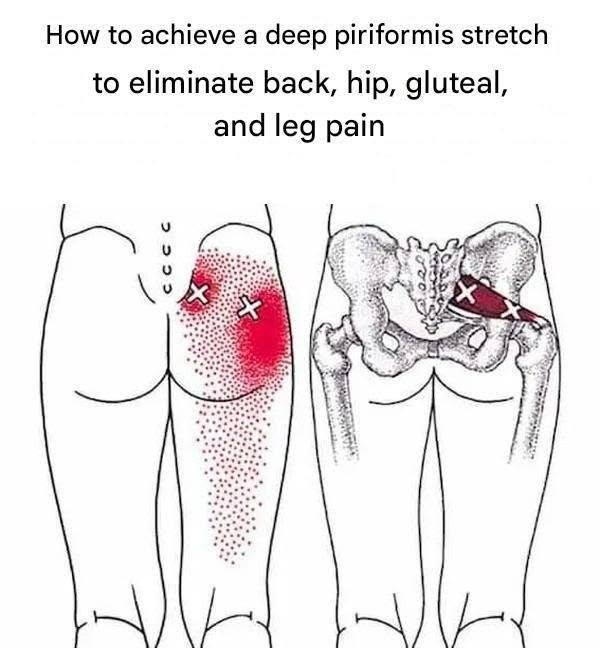
A tight piriformis muscle can contribute to pain in the buttock and, in some cases, symptoms that resemble sciatica. However, there is no single stretch that can reliably “eliminate” back, hip, gluteal, and leg pain, because those symptoms can have many different causes.
If your pain is related to a tight piriformis, these stretches may help:
1. Figure-4 Stretch (Most Common)
- Lie on your back with both knees bent.
- Cross your right ankle over your left knee.
- Reach behind your left thigh and gently pull it toward your chest.
- You should feel a stretch deep in the right buttock.
- Hold for 20–30 seconds and repeat 2–4 times on each side.
2. Knee-to-Opposite-Shoulder Stretch
- Lie on your back.
- Pull one knee toward your chest.
- Gently guide it toward the opposite shoulder.
- Hold for 20–30 seconds, then switch sides.
3. Seated Piriformis Stretch
- Sit upright in a chair.
- Cross one ankle over the opposite knee.
- Keep your back straight and lean forward from your hips until you feel a gentle stretch in your buttock.
- Hold for 20–30 seconds.
4. Pigeon Pose (Yoga)
- From hands and knees, bring one knee forward and extend the other leg behind you.
- Keep your hips as level as is comfortable.
- Lean forward only until you feel a mild stretch.
- Hold for 20–45 seconds.
Tips for best results
- Warm up with 5–10 minutes of walking or other light activity.
- Stretch gently—don’t bounce or force the movement.
- Repeat daily if it feels helpful.
- If prolonged sitting makes your symptoms worse, stand up and move around every 30–60 minutes.
When stretching may not help
Pain in the back, hip, buttock, or leg can also come from conditions such as a herniated disc, arthritis, hip disorders, or other nerve problems. If stretching makes your pain worse, or if you have:
- severe or worsening pain,
- significant leg weakness,
- numbness in the groin area,
- or loss of bladder or bowel control,
seek prompt medical evaluation.
For many people with persistent piriformis-related pain, a combination of gentle stretching, strengthening the gluteal and core muscles, and addressing posture and movement habits is more effective than stretching alone.
