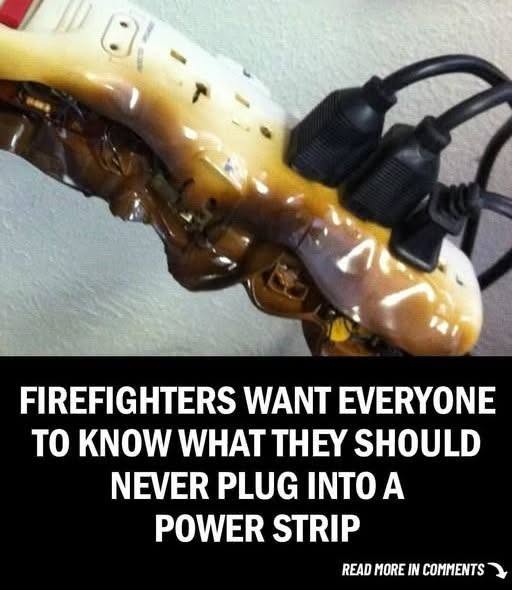
Things You Should Never Plug Into a Power Strip ⚠️
Power strips are convenient for low-power electronics, but some appliances draw too much electricity and can overheat the strip, trip breakers, or create a fire risk. A power strip should not be treated like a replacement for a wall outlet.
genui{“physics_electricity_magnetism_learning_block”:{“type_id”:”DC_CIRCUIT_POWER”}}
1. Space heaters
🚫 Do not plug a space heater into a power strip.
Why:
- Space heaters use a lot of electricity.
- The high current can overheat the power strip and its wiring.
Safer option: Plug the heater directly into a wall outlet.
2. Air conditioners and portable cooling units
🚫 Avoid plugging air conditioners into standard power strips.
Why:
- Compressors require high startup power.
- Overloading can damage wiring or cause overheating.
3. Refrigerators and freezers
🚫 Avoid power strips for large refrigeration appliances.
Why:
- Motors and compressors can create heavy electrical loads.
- A dedicated wall outlet is usually recommended.
4. Microwaves
🚫 Do not plug microwaves into a typical power strip.
Why:
- Microwaves draw significant power while operating.
- The load may exceed the strip’s rating.
5. Toasters, toaster ovens, and air fryers
🚫 These heating appliances can be risky on power strips.
Why:
- Heating elements require high wattage.
- The strip may overheat even if the appliance works at first.
6. Coffee makers and electric kettles
⚠️ Use caution.
Many small kitchen appliances have heating elements that draw substantial power. Plugging several of them into one strip can overload the circuit.
7. Hair dryers and curling tools
🚫 Avoid using power strips for high-wattage hair appliances.
Why:
- They can pull a large amount of current quickly.
- Bathroom environments also increase electrical safety concerns.
8. Another power strip (“daisy chaining”)
🚫 Do not plug one power strip into another.
Why:
- It can overload the circuit.
- It increases the chance of overheating.
What is usually OK to plug into a power strip?
Generally lower-power electronics such as:
✅ Phone chargers
✅ Computers and monitors
✅ TVs
✅ Game consoles
✅ Lamps
(Always check the power strip’s rating and use a quality, safety-certified product.)
Safety tips
- Replace strips that are cracked, damaged, warm to the touch, or have a burning smell.
- Avoid covering power strips with rugs or furniture.
- Do not use indoor power strips outdoors unless specifically rated for it.
- Use surge protectors for sensitive electronics, but remember: a surge protector does not make a high-power appliance safe to plug into it.
Bottom line: If an appliance produces heat, cools a room, or uses a motor/compressor, it usually belongs directly in a wall outlet, not a power strip.
