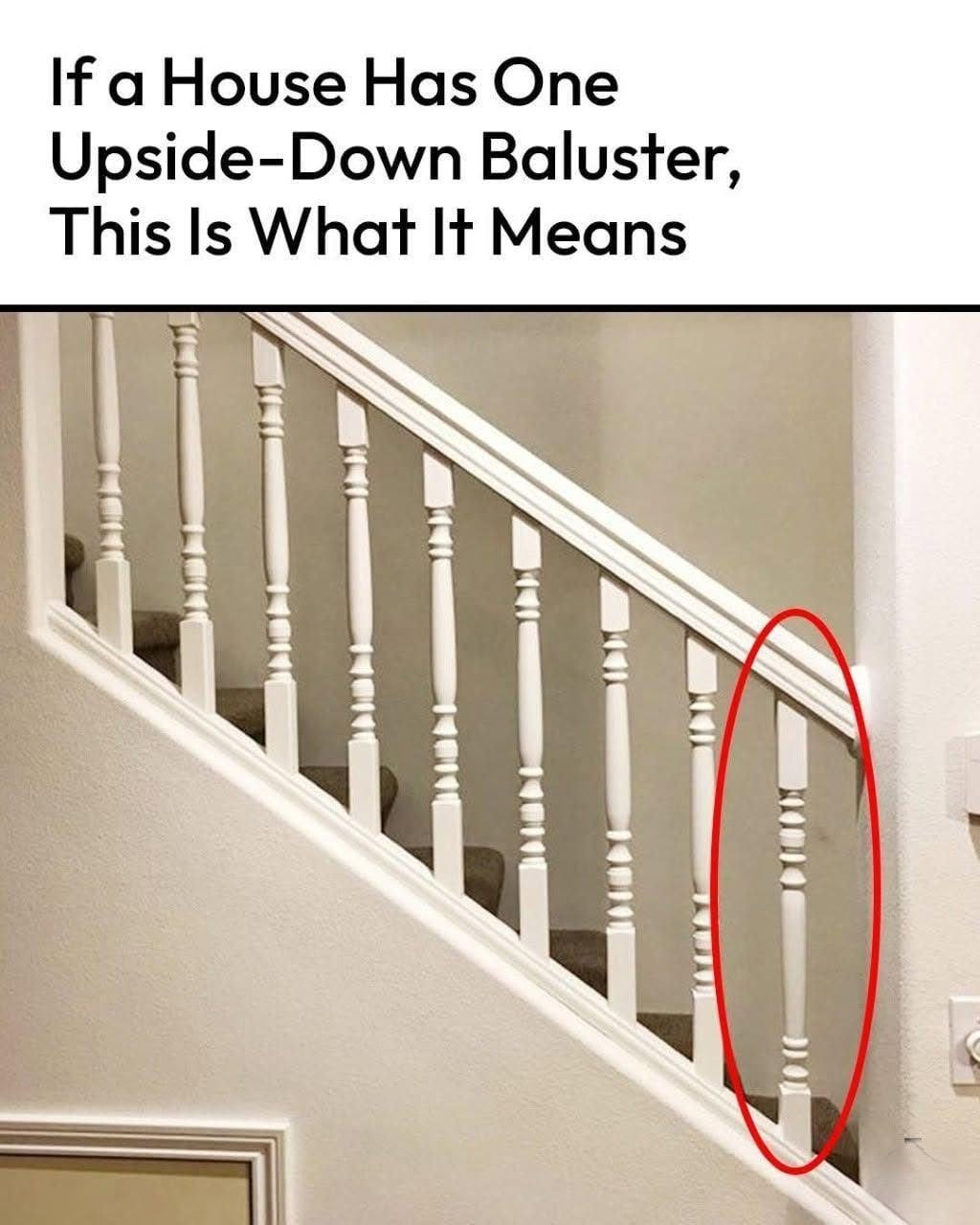
If a House Has One Upside-Down Baluster, What Does It Mean?
An upside-down baluster (the vertical spindle in a staircase or porch railing) often attracts attention because it looks intentional. Many stories claim it has a special meaning, but the truth depends on the house and its history.
Here are the most common explanations:
1. A Craftsman’s Signature (Popular Tradition)
One long-standing tradition says that a carpenter or woodworker intentionally installed one baluster upside down as a personal signature or mark of pride.
The idea was that:
- No human work is perfect.
- Only perfection belongs to God.
While this story is widely repeated, there is limited historical evidence that it was a widespread building practice.
2. A Symbol of Humility
Another tradition holds that the inverted baluster was a reminder that:
- Humans are imperfect.
- Every handcrafted project should contain a small imperfection.
This belief appears in various folk traditions but is not a universal architectural custom.
3. A Decorative or Practical Choice
In some homes, an upside-down baluster may simply be the result of:
- A repair or renovation
- A replacement using an available matching piece
- A construction mistake that was never corrected
- A decorative design choice
Not every inverted baluster has symbolic meaning.
4. Local Folklore
Different regions have developed their own stories. Some people believe an upside-down baluster:
- Brings good luck
- Commemorates a family event
- Marks the completion of a home
These interpretations vary and are generally part of local folklore rather than documented building traditions.
The Bottom Line
An upside-down baluster is not a universal architectural symbol. In some homes it may have been placed intentionally as a symbol of humility or craftsmanship, while in others it may simply be the result of a repair, a design choice, or an installation error. Without historical records from the specific house or builder, it’s usually impossible to know the exact reason.
