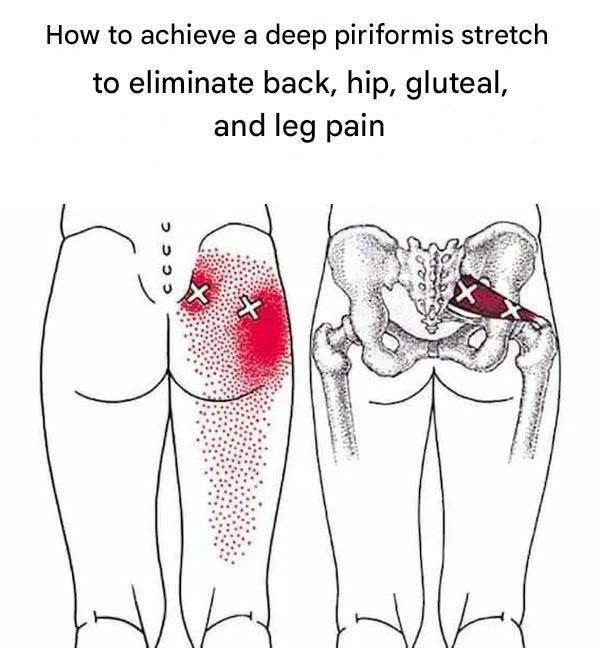
The piriformis stretch can help reduce tension in the deep gluteal muscles that sometimes contribute to buttock pain or sciatic-type discomfort—but it’s important to be clear: it doesn’t “eliminate” all back, hip, or leg pain. Those symptoms can come from several causes (disc issues, nerve compression, arthritis, etc.), and stretching alone won’t fix everything.
If the piriformis muscle is tight, though, these are the most effective, safe ways to target it:
1. Classic Figure-4 stretch (most effective starting point)
Lie on your back with knees bent.
Place your right ankle over your left thigh (just above the knee), forming a “4.”
Gently pull your left thigh toward your chest until you feel a deep stretch in the right glute.
Hold 20–40 seconds, repeat 2–3 times per side.
This is the most commonly recommended variation of the Piriformis stretch because it directly targets the deep external rotators of the hip.
2. Seated figure-4 (good for daily use)
Sit on a chair.
Cross one ankle over the opposite knee.
Keep your back straight and lean forward slightly.
You’ll feel the stretch in the outer hip/glute.
Useful if you sit for long hours (a common cause of tightness).
3. Supine knee-to-opposite-shoulder stretch
Lie on your back.
Bring one knee toward the opposite shoulder.
Hold gently without forcing.
This helps release deeper glute tension and can feel more targeted than the basic stretch.
4. Pigeon pose (advanced, deeper stretch)
From a yoga position, bring one leg forward bent and extend the other back.
Lower your torso forward gradually.
This gives a strong stretch but should be done carefully—don’t force it if you feel knee or sharp nerve pain.
Important technique tips
- Stretch should feel like a deep pull in the glute, not sharp pain.
- Keep breathing slow—don’t hold your breath.
- Warm up slightly first (even a 5-minute walk helps).
- Do both sides, even if only one side hurts.
When stretching is NOT enough
If pain radiates down the leg, causes numbness, tingling, or worsens with sitting, it may involve the sciatic nerve or lumbar spine—not just the piriformis. In those cases, you may need strengthening exercises (glutes/core) or medical evaluation.
If you want, I can build you a 10-minute daily routine that combines piriformis release + hip strengthening so the pain doesn’t keep coming back.
