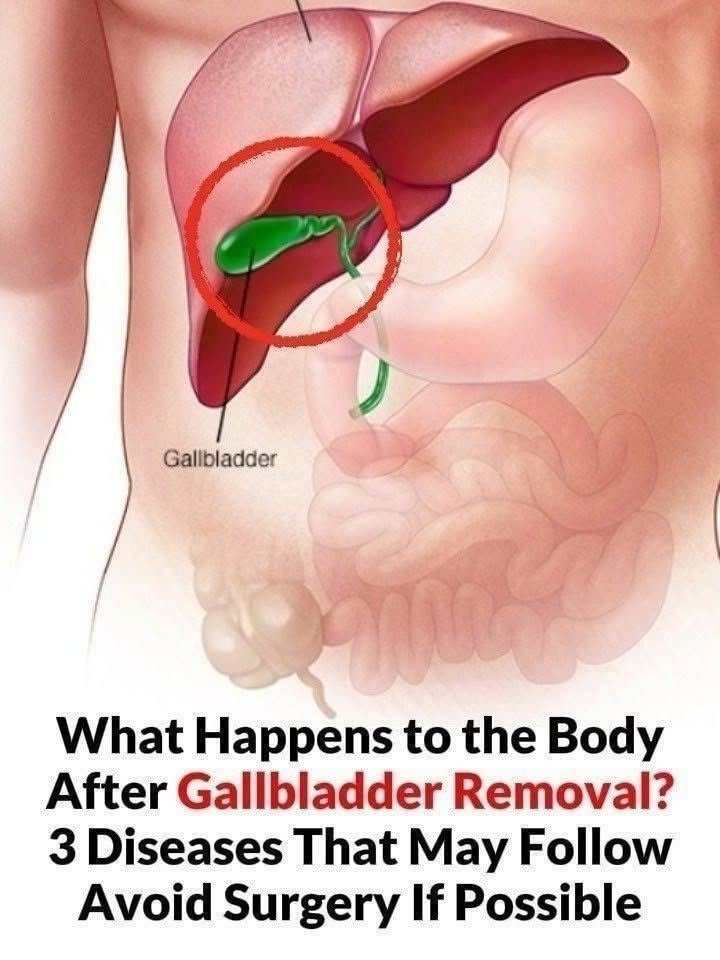
That headline is also misleading. Gallbladder removal is not something doctors “push unnecessarily”—it’s one of the most common and well-studied surgeries, and when it’s needed, it often prevents serious complications.
The surgery is called a cholecystectomy, done for conditions like recurrent gallstones, gallbladder inflammation, or blockage.
Let’s separate facts from fear-based claims.
First: Is it better to “avoid surgery when possible”?
Yes—but only in a medical sense.
If you have:
- Mild, asymptomatic gallstones
- No inflammation or complications
Doctors often recommend watchful waiting.
But if you have:
- Repeated gallbladder attacks
- Infection or inflammation
- Blocked bile ducts
- Pancreatitis from gallstones
Then surgery is usually the safest long-term option, not something to avoid.
Now the “3 conditions” people claim after gallbladder removal:
After removal of the gallbladder (cholecystectomy), most people do fine. However, a minority experience some digestive changes:
1. Post-cholecystectomy diarrhea
Without a gallbladder, bile flows continuously into the intestine instead of being stored.
This can sometimes lead to loose stools, especially after fatty meals.
Usually:
- Temporary
- Improves over weeks to months
- Managed with diet adjustments
2. Bile reflux or indigestion symptoms
Some people experience:
- Bloating
- Upper abdominal discomfort
- Heartburn-like symptoms
This happens due to altered bile flow, but it is not common in severe form.
3. Post-cholecystectomy syndrome
A broad term for persistent digestive symptoms after surgery.
Causes may include:
- Residual bile duct stones
- Irritable bowel-type symptoms
- Sensitivity to fat digestion changes
Important: this is not a single disease, and most cases are treatable or mild.
What’s often left out of fear-based content
Most people do NOT develop serious long-term problems
The majority adapt well because:
- The liver still produces bile
- Digestion continues normally
- The body compensates over time
Not treating gallbladder disease can be riskier
Untreated gallstones can lead to:
- Severe infection (cholecystitis)
- Pancreatitis (can be life-threatening)
- Bile duct blockage
- Emergency surgery instead of planned surgery
Bottom line
Gallbladder removal is not something to “avoid at all costs.” It’s:
- Optional in mild cases
- Necessary in symptomatic or complicated cases
- Generally safe and routine
The real decision is not “surgery vs no surgery,” but risk of surgery vs risk of leaving the disease untreated.
If you want, I can explain how to tell when gallbladder symptoms are mild vs when surgery becomes medically necessary—that’s usually where the confusion starts.
